

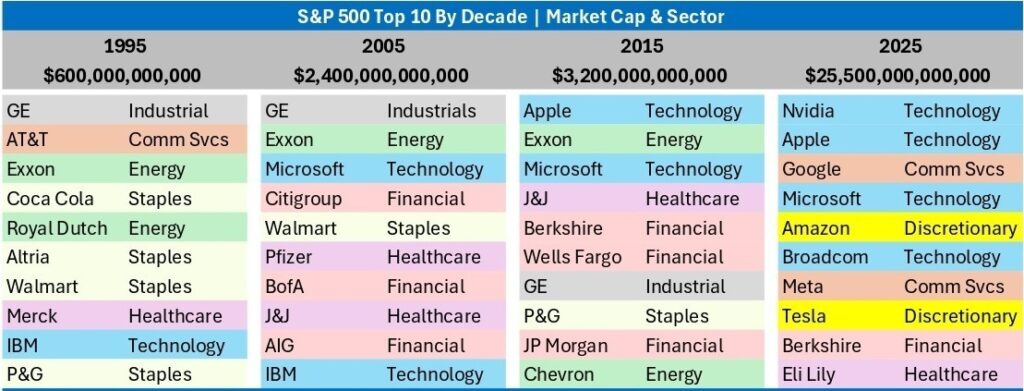
Every so often, it is worth pausing to look back at how the U.S. equity market has evolved, as this is helpful to both inform and frame our outlook for the future. In doing so, a key constant that emerges is change.
We’ve seen time and again that what drives the market evolves over time. Over long periods, the market follows the earnings trajectories of its underlying constituents. These earnings are influenced by broad economic forces and, importantly, structural change.
THREE DECADES OF MARKET SHIFTS
Just in the past few decades we’ve seen:
1995 to 2005
The rise and fall of technology, media, and telecommunications (TMT). At their peak, TMT companies made up nearly 30% of the S&P 500. Enthusiasm for widespread internet adoption drove valuations of many speculative companies to unsustainable levels. Leadership rotated sharply to more defensive and traditional sectors (e.g., financials, energy, industrials, and consumer staples) in the aftermath of the collapse.
2005 to 2015
The Global Financial Crisis (GFC) and fall of financials. Financial stocks fell dramatically as the housing market collapsed and credit markets froze. Energy companies emerged as a dominant force for part of the decade, supported by global demand and the early years of the U.S. shale boom.
2015 to 2025
The current period is often described as the “platform era.” Software-driven ecosystems have reshaped how businesses operate and how consumers live. Tech has dominated and the Magnificent Seven (Alphabet, Amazon, Apple, Meta Platforms, Nvidia, and Tesla) has emerged. Market concentration has risen to historic levels. Large tech firms have benefited from scale, network effects, and the rapid rise of artificial intelligence (AI).
Understanding Regime Change
Investment professionals often refer to these transitions as “regime change.” They occur when the underlying drivers of market performance shift in meaningful ways. Regime change is often triggered by a major disruption or series of disruptions. A few examples include: macro shocks (i.e., recession, inflation), policy shifts (i.e., monetary/fiscal, regulation), and technological inflections (i.e., internet, smartphones, and, recently, artificial intelligence).

What This Means for Investors Today
Said John Maynard Keynes, “When the facts change, I change my mind. What do you do, sir?”
The key here is that change is inevitable. Remember that each era’s leaders look permanent in real-time, yet history shows this is rarely the case. This is something we are constantly mindful of at Carlson Investments in our investment process.
We think now is an important time to reflect on this as we consider some of the dynamics the global market is presenting today.
If you would like to discuss how Carlson Investments evaluates evolving market regimes and how this approach may apply to your financial plan, you can reach our team through our contact page.
Carlson Investments does not provide tax, legal, or accounting advice. This content has been written for informational purposes only. Always consult your individual tax, legal, or financial professionals for advice tailored to your situation
Let's Talk
Finding a better way doesn’t start with you learning about investment strategy. It starts with us learning about you.
Let’s get started.
Contact Us