

Saving and investing for a child or grandchild can open doors for years to come. But with more options available than ever, one of the first questions families often ask is, “Which account should I open?”
A better question may be: What do I hope this money will eventually help them do?
Pay for college? Learn a trade? Buy a first home? Get an early start on retirement? Or simply have a financial foundation that gives them more choices as they enter adulthood?
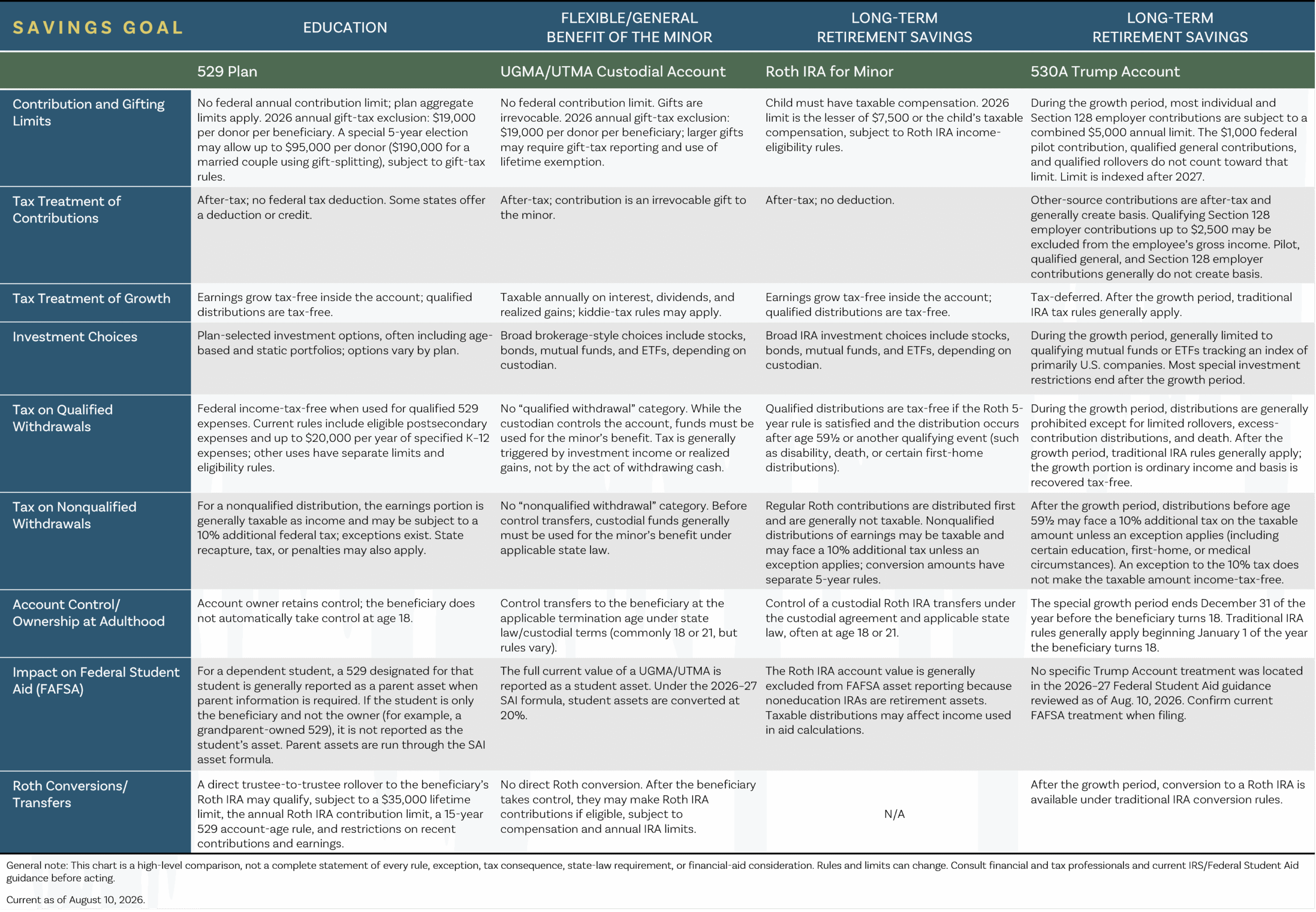
Today, families can choose from familiar options such as 529 education savings plans and Uniform Gifts to Minors Act/Uniform Transfers to Minors Act (UGMA/UTMA) custodial accounts, as well as Roth IRAs for working minors and the new Section 530A Trump Accounts. Each comes with different rules governing contributions, taxes, withdrawals, investments, and ownership. In many cases, the best strategy may involve more than one.
There are also far more details and potential planning considerations associated with each account than we can cover in a single article. Think of this as a starting point: an overview of the major differences and the questions that can help you determine which options deserve a closer look with your financial and tax advisors.
Start With the Goal, Not the Account
Before deciding where to put the money, define what you want it to accomplish.
This can also be an opportunity for a broader family conversation. Parents, grandparents, and other relatives can discuss who wants to contribute, how much flexibility they want the child to have later and what values they hope the gift will reflect. Those conversations can help determine not only which accounts make sense, but who should own them.
As we discussed in our article on life stage investing, financial decisions are most useful when they are aligned with what matters at a particular point in life. The same principle applies when saving for the next generation.
Here are four of the primary options families may want to consider.
If Education Is the Priority: Consider a 529 Plan
 For families primarily focused on education, a 529 plan remains one of the most attractive options.
Contributions are made with after-tax dollars at the federal level, although some states offer tax benefits. Investments grow tax-free, and withdrawals are generally federal income tax-free when used for qualified education expenses.
The range of eligible expenses has recently expanded. In addition to qualified higher education expenses, 529 funds can be used for K–12 education up to $20k/year per beneficiary, apprenticeships, student loan repayment, and other education-related expenses. Always confirm the current rules before making a withdrawal. The IRS provides additional information about qualified tuition programs and their tax treatment.
A 529 can also offer flexibility if the original beneficiary does not need all the money. Depending on the circumstances, the account owner may be able to:
- Change the beneficiary to another qualifying family member.
- Use remaining funds for graduate school or other qualified education.
- Use a limited amount for qualified student loan repayment.
- Transfer eligible unused funds to the beneficiary’s Roth IRA.
Under current law, up to $35,000 over a beneficiary’s lifetime may potentially be transferred from a 529 into that beneficiary’s Roth IRA. Certain conditions apply, including rules governing how long the 529 has been open and annual Roth IRA contribution limits.
529 plans can also play a role in gifting strategies. Families with the means to make larger gifts may be able to take advantage of special five-year gift tax averaging rules for 529 contributions. Because gift tax exclusions and related rules can change, families considering larger contributions should coordinate with their tax and financial professionals.
Financial aid can be another consideration. Under current FAFSA methodology, the treatment of 529 assets depends in part on who owns the account, which is one reason families may want to consider account ownership as part of the planning process. “Nowadays only a small portion of the 529 plan assets have an impact on FAFSA scoring, and no impact when owned by a non parent, says portfolio manager, Kate Graham, “which makes 529s a great choice.”

If Flexibility Is the Priority: Consider a UGMA or UTMA Account
What if your goal is broader than education?
Perhaps you would like the money to eventually help with a first car, a home down payment, medical expenses, or another important milestone.
A UGMA or UTMA custodial account offers considerably more flexibility in how funds can be used for the minor. The custodian manages the account while the beneficiary is a minor, and the account can hold investments such as stocks, bonds, mutual funds, and ETFs.
That flexibility comes with tradeoffs.
Unlike a 529, investment income and realized gains in a custodial account may be taxable. UGMA/UTMA accounts are taxed in 3 tiers on unearned income (interest, dividends, capital gains), with the first $1,350 (2025/2026) exempt, the next $1,350 taxed at the child’s rate, and amounts over $2,700 taxed at the parents’ marginal rate.
There is another important distinction: the money belongs to the child. At the applicable age under state law, typically 18 or 21, control of the account transfers to the beneficiary. That makes financial education an important part of the strategy.
“We sometimes encourage parents and grandparents to write a letter to the child explaining why they saved the money and what they hope it will help the young adult accomplish”, says Graham, “You cannot dictate every decision the child will eventually make, but you can give the gift context.”
Better yet, involve children in conversations about the account as they get older. A custodial account can become an opportunity to talk about investing, saving, and the responsibility that comes with managing money.
Once a Child Has Earned Income: Consider a Roth IRA
A Roth IRA for a minor may be one of the most overlooked ways a young person can get a head start.
Once a child has earned income, whether from a summer job, part-time work, or other qualifying compensation, a custodial Roth IRA becomes an option. For 2026, IRA contributions are limited to the lesser of the child’s taxable compensation or $7,500, according to the IRS IRA contribution limits.
For example, if a teenager earns $3,000 during the year, no more than $3,000 may generally be contributed to their IRA for that year.
Why start so young? Time.
Giving investments decades to compound can have a powerful effect. It also gives young people an opportunity to learn about investing while the amounts involved are still relatively small.
Families can make the process educational, too. A teenager with a first job can learn the basics of investing, discuss how the account is invested, and begin seeing the relationship between earning, saving, and long-term financial goals.
A New Option for Children: Trump Accounts
Families now have another savings vehicle to consider: Trump Accounts, established under Section 530A of the Internal Revenue Code.
Trump Accounts are a new type of IRA created specifically for children. Eligible children born between January 1, 2025, and December 31, 2028 may qualify for a one-time $1,000 federal pilot program contribution. Even children who do not qualify for the $1,000 contribution may potentially have a Trump Account if they otherwise meet the eligibility requirements.
During the account’s growth period, contributions from individuals and employers are generally subject to a combined $5,000 annual limit, with certain exempt contributions treated differently. Unlike a Roth IRA for a minor, a child does not need earned income for these contributions.

After the growth period, Trump Accounts generally become subject to the distribution rules applicable to traditional IRAs. Early withdrawals may be subject to ordinary income tax and a 10% additional tax unless an exception applies, such as certain qualified higher education expenses, qualifying first-time home purchases, or qualifying medical expenses. Because each exception has specific requirements and limitations, families should review the applicable rules before taking a distribution.
Employers may provide another opportunity. Beginning in 2026, qualifying employer programs may make contributions to Trump Accounts for employees with qualifying dependents, subject to applicable annual limits and tax rules.
Because Trump Accounts are brand new, this is one area where families should be particularly careful about relying on a general overview. Treasury and IRS guidance continues to develop, and additional rules may affect contributions, investments, withdrawals, financial aid, and taxation. Families interested in this option should review the latest information at TrumpAccounts.gov and coordinate with their financial and tax professionals.
You May Not Have to Choose Just One
For many families, this is not an either-or decision.
A child could potentially have a 529 for education, a custodial account for greater flexibility and, once they begin earning income, a Roth IRA for long-term retirement savings. Eligible families might add a Trump Account to that mix as well.
The right combination depends on several questions:
- What is the primary goal? Education, general financial support, retirement, or a combination?
- How much control do you want to retain? A 529 account owner generally maintains control, while custodial assets eventually become the child’s property.
- How important is tax efficiency? Different accounts receive very different tax treatment.
- Who wants to contribute? Parents, grandparents, and other relatives may each have different financial, tax, and estate planning considerations.
- Could financial aid be a consideration? Account type and ownership can affect financial aid calculations differently.
- When might the child need the money? An account designed for retirement will have very different rules than one intended to help with expenses in early adulthood.
This is where looking at the family’s entire financial picture matters. An account that is ideal for one goal may be less attractive for another.
Make Saving Part of a Family Conversation
Whatever accounts you choose, consider making the process part of a larger conversation about money.
Grandparents might contribute toward a child’s future for birthdays, holidays, or special occasions. A teenager with a first job might learn how a Roth IRA works and participate in discussions about investing. Parents can explain why the family is setting money aside and what opportunities they hope it creates.
Contributions matter, but so does the lesson behind it.
Even small, consistent contributions made over many years can add up. More importantly, starting early gives a child something that cannot be recreated later: time.
Saving for the next generation can be about much more than funding college or retirement. Done thoughtfully, it can help families pass along financial knowledge, good habits, and a clearer understanding of what money can help them accomplish.

The Right Starting Point Is a Conversation
There is no single “best” account for saving for a child or grandchild. The right answer depends on what you hope the money will accomplish, who is contributing, how much flexibility you want, the child’s age and income, your tax situation, and how these decisions fit into the family’s broader financial plan.
There is considerably more to each of these accounts than we can cover here. Contribution rules, tax treatment, eligible withdrawals, financial aid considerations, and ownership requirements can all include important exceptions and details. Rules can also change over time.
That is why we view these accounts as planning tools rather than products to choose in isolation.
At Carlson Investments, we help families look beyond the account names and consider how education savings, gifting, retirement planning, and support for the next generation fit together. If you are considering one or more of these accounts, contact our team to discuss your family’s goals and access additional resources that can help you explore the rules and planning considerations in greater detail.
This article provides a general overview of savings and investment accounts that may be available for minor children. It is not intended to address every rule, restriction, tax consideration, or planning strategy associated with these accounts. Account rules and contribution limits may change, and individual circumstances vary. Consult your financial and tax professionals before opening an account, making contributions or withdrawals, or implementing any of the strategies discussed above.
Carlson Investments does not provide tax, legal, or accounting advice. This content has been written for informational purposes only. Always consult your individual tax, legal, or financial professionals for advice tailored to your situation.
Carlson Investments is a Concord, New Hampshire-based financial advisor and investment manager.
Let's Talk
Finding a better way doesn’t start with you learning about investment strategy. It starts with us learning about you.
Let’s get started.
Contact Us