

Turning 65 brings an important retirement decision: how to structure your healthcare coverage once Medicare becomes available.
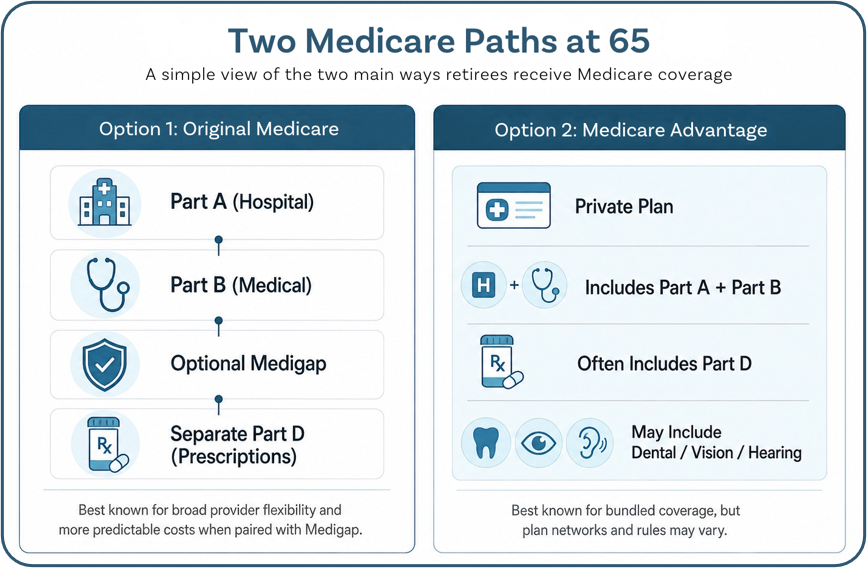
For most retirees, there are two primary paths: You can choose Original Medicare, often paired with a Medigap policy and separate prescription drug coverage, or enroll in a private Medicare Advantage plan. Both can be effective. The right choice depends on factors such as your preferred doctors, travel plans, prescriptions, budget, and desire for flexibility.
You do not need to become a Medicare expert. However, understanding the basic tradeoffs can help you make informed decisions that affect your healthcare and retirement spending for years to come.
Sources: Medicare.gov, National Council on Aging
⭐ Important ⭐: If you plan to work past age 65 and have employer-sponsored healthcare, speak with your human resources department about whether you need to enroll in Medicare during your initial enrollment period. Requirements depend on your employer and its health plan. Enrolling late can lead to penalties, including premium increases that may continue for as long as you have Medicare, even if you were not yet retired.
Start With the Basics
Medicare is federal health insurance that generally becomes available at age 65. It comprises multiple parts:
- Part A primarily covers hospital care.
- Part B primarily covers doctors, outpatient services, medical equipment, and many preventive services.
Together, Parts A and B are known as Original Medicare.
- Medicare Advantage, also known as Part C, is an alternative way to receive Medicare benefits through a private insurance company.
We often see people get tripped up assuming Medicare means healthcare becomes free at 65. It doesn’t. Premiums, deductibles, copayments, prescriptions, dental, vision, hearing, and long-term care can all still affect your retirement budget.
The core decision is how you want to structure and manage those costs.
OPTION 1: Original Medicare

With Original Medicare, the federal government administers your covered hospital care, doctor visits, and so forth (Part A and Part B coverage).
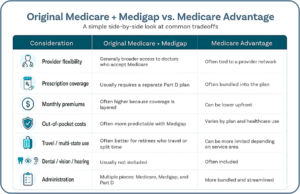
One of the primary benefits is flexibility. You can see any doctor or go to any hospital in the country that accepts Medicare. For someone who travels frequently, spends part of the year in another state, or sees multiple specialists, that flexibility can be valuable.
The tradeoff is that Original Medicare does not cover every dollar of care. You are still responsible for deductibles and coinsurance, and Original Medicare by itself does not place an annual limit on out-of-pocket spending.
For this reason, we recommend most retirees consider adding Medigap coverage.
Where Medigap Fits
Medigap, or Medicare Supplement Insurance, is private insurance that works alongside Original Medicare.
In practical terms, Medigap allows you to exchange some potentially unpredictable medical expenses for a more predictable monthly premium. Medicare pays its share of a covered expense first. Your Medigap policy may then cover some or most of the remaining cost, depending on the policy you select.
Medigap does not cover everything. Prescription drugs require a separate Part D plan, and Medigap typically does not cover routine dental, vision, hearing, or long-term custodial care.
Someone using Original Medicare may therefore have three components to their coverage:
- Original Medicare
- A Medigap policy
- A Part D prescription drug plan
This approach results in higher upfront monthly premiums, but it provides greater predictability when medical expenses occur. Consider medigap a hedge against higher medical expenses that become more frequent with age.
OPTION 2: Medicare Advantage
Medicare Advantage takes a different approach.
Rather than receiving your benefits directly through Original Medicare, you enroll in a Medicare-approved plan offered by a private insurer.
Many Medicare Advantage plans combine hospital, medical, and prescription drug coverage. Some also include benefits for dental, vision, hearing, or other services.
While this bundled structure may appear appealing, there are, however, important tradeoffs to consider.
Medicare Advantage plans use specific provider networks and establish requirements for referrals or prior authorization. Coverage is also typically more closely tied to a particular geographic service area.
Someone who receives most healthcare services locally can find that arrangement suitable. But someone who travels often or values broad access to physicians and specialists should lean toward the flexibility of Original Medicare + Medigap.
Sources: Medicare.gov, National Council on Aging
How Should You Evaluate the Choice?
 Rather than beginning with the plan that has the lowest premium, consider how you expect to use healthcare.
Questions to consider include:
- Do you have doctors you want to continue seeing?
- Do you travel or spend significant time outside your home state?
- How important is broad access to specialists?
- Would you prefer higher monthly premiums and more predictable costs, or lower premiums with greater variability when you need care?
- What prescriptions do you currently take?
These questions often provide a more useful basis for comparison than monthly premiums alone.
It is also highly important to consider how your needs may change. Medicare is not simply coverage for age 65. You are selecting a structure that can continue to serve you throughout retirement as your healthcare needs evolve.
Timing Matters
Planning ahead is particularly important when it comes to Medigap enrollment.
Your Medigap Open Enrollment Period lasts for six months, beginning when you are at least 65 and enrolled in Medicare Part B. During that window, insurers generally cannot deny you Medigap coverage or charge you more because of a pre-existing health condition.
Purchasing or changing Medigap coverage later becomes more complicated… Depending on your circumstances and state regulations, you may face higher costs, or fewer policy options.
This does not mean you can never change coverage. It just means you should not assume that the same options will always be available to you without additional costs or restrictions
Consider Medicare Within Your Broader Retirement Plan
Healthcare is an important retirement expense, and Medicare decisions intersect with other areas of your financial plan.
For example, higher-income retirees may pay additional Part B and Part D premiums through the Income-Related Monthly Adjustment Amount, commonly known as IRMAA. This surcharge is generally based on income reported on your federal tax return from two years earlier.
As a result, decisions such as completing a large Roth conversion, realizing significant capital gains, or taking a substantial retirement account distribution could affect future Medicare premiums.
Healthcare, taxes, investment withdrawals, Social Security, and cash flow should be considered as parts of a coordinated strategy rather than separate decisions. We can’t emphasize enough that retirement is not a single event. It is a series of decisions that build upon one another.

The Bottom Line
As you approach age 65, you need to understand how the decisions you are making flow through your retirement plan.
Original Medicare provides broader access to providers and when paired with Medigap and Part D provides a more predictable coverage. Although Medicare Advantage offers a simpler, bundled approach, it has more plan-specific rules and provider-network restrictions.
There is no single right answer for everyone.
At Carlson Investments, we help clients understand how healthcare expenses fit within the broader retirement picture. Evaluating Medicare alongside taxes, investment withdrawals, Social Security, and cash flow leads to a more informed and coordinated approach.
If you are approaching Medicare eligibility or preparing to leave employer coverage, contact the Carlson Investments team to discuss how Medicare may fit into your broader retirement plan before your enrollment window arrives.
Helpful Resources
This material is for informational purposes only and is not a recommendation of any insurance policy or provider. Medicare rules, costs, state protections, policy availability, and underwriting practices may change. Consult Medicare, your State Health Insurance Assistance Program, and a licensed insurance professional regarding your individual circumstances.
Carlson Investments is a Concord, New Hampshire-based financial advisor and investment manager.
Carlson Investments does not provide tax, legal, or accounting advice. This content has been written for informational purposes only. Always consult your individual tax, legal, or financial professionals for advice tailored to your situation.
Let's Talk
Finding a better way doesn’t start with you learning about investment strategy. It starts with us learning about you.
Let’s get started.
Contact Us