

Many organizations describe themselves as long-term investors. Yet when markets become volatile or spending needs increase, even well-intentioned institutions can find themselves reacting to short-term events.
For endowments, that can create a significant challenge.
An endowment’s purpose is not simply to generate returns this quarter or next year. It is to provide ongoing financial support for an institution’s mission, often for generations to come. Achieving that goal requires more than patience. It requires a disciplined investment framework that can endure changing market conditions, leadership transitions, and economic cycles.

Built for the Long Run
Unlike many investment portfolios that are designed around a specific future date or spending objective, endowments are perpetual by nature. They must support today’s needs while preserving purchasing power for future beneficiaries.
That unique structure allows endowments to think differently about investing.
Rather than focusing on short-term market movements, successful endowments typically build portfolios designed to compound over decades. Their emphasis is on maintaining a disciplined strategy through market cycles rather than attempting to predict every twist and turn along the way.
This approach has helped some of the nation’s most successful endowments achieve strong long-term outcomes despite periods of market uncertainty.
The Power of Diversification
One characteristic shared by many leading endowments is broad diversification across asset classes.
According to the 2025 Endowment Study from Crystal Capital Partners, the eight Ivy League university endowments allocate approximately 75% of their assets to private equity, venture capital, hedge funds, and real assets, while maintaining more limited exposure to traditional public markets.
While most organizations do not have the same resources, access, or scale as large university endowments, the underlying principle remains relevant: diversification can help reduce dependence on any single market environment.
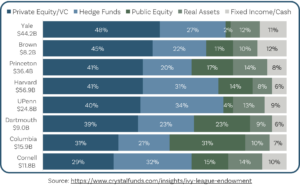
A thoughtfully diversified portfolio may include a mix of public equities, fixed income, private investments, real assets, and other strategies, depending on an institution’s objectives, liquidity requirements, and risk tolerance.
The goal is not to mimic Ivy League portfolios. The goal is to create an investment strategy aligned with the institution’s unique mission and long-term needs.
Governance Often Matters More Than Market Forecasts
Strong investment results rarely come from making frequent predictions about where markets are headed next. Instead, they often come from consistent governance and disciplined execution.
A well-constructed Investment Policy Statement serves as the foundation of an endowment program. It can help define:
- The organization’s mission and investment objectives.
- Spending policies and liquidity requirements.
- Asset allocation targets.
- Risk management guidelines.
- Roles and responsibilities for decision-makers.
When governance structures are clearly defined, boards and committees are often better positioned to make decisions based on long-term objectives rather than short-term emotions.
This discipline becomes particularly valuable during periods of market volatility when the temptation to abandon a carefully designed strategy can be strongest.

Why Rebalancing Matters
One often overlooked aspect of long-term investing is portfolio maintenance.
Over time, market performance can cause a portfolio’s asset allocation to drift significantly from its original targets. For example, a portfolio initially structured as 60% equities and 40% fixed income may gradually become much more equity-heavy after a prolonged stock market rally.
Without periodic rebalancing, institutions can unintentionally take on more risk than intended.
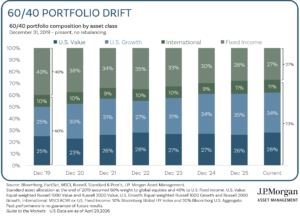
As highlighted in the Q2 2026 J.P. Morgan Guide to the Markets, disciplined rebalancing helps maintain alignment between a portfolio’s risk profile and its long-term objectives.
Regular rebalancing is not about predicting market movements. It is about ensuring the portfolio continues to reflect the strategy that was established in the first place.
A Long-Term Mindset Creates Long-Term Opportunity
At its core, successful endowment investing is about balance.
Institutions must meet today’s spending needs while preserving resources for future generations. They must remain disciplined during periods of market stress while continuing to pursue growth opportunities that may take years to fully develop.
As Mike Leary, Senior Vice President of Development for Easterseals NH & VT, explains, “We seek to balance our immediate needs with a long-term investment strategy that can support those who count on us now while building a strong foundation for the future.”
That balance is what makes endowment investing unique.
A long-term strategy is not simply about staying invested. It is about creating a framework that aligns investment decisions with organizational goals, embraces diversification, maintains discipline through market cycles, and remains focused on the mission the endowment was created to support.
If your organization is evaluating its investment strategy, governance structure, or endowment management approach, contact Carlson Investments to start a conversation about building an investment framework designed to support your mission for years to come.
Carlson Investments does not provide tax, legal, or accounting advice. This content has been written for informational purposes only. Always consult your individual tax, legal, or financial professionals for advice tailored to your situation.
Let's Talk
Finding a better way doesn’t start with you learning about investment strategy. It starts with us learning about you.
Let’s get started.
Contact Us