

For many investors, international stocks have become easy to overlook.
Over the past 15 years, U.S. markets have delivered impressive returns, fueled largely by the dominance of major technology companies. When one area of the market performs this well for this long, it is natural to question whether investing internationally is still necessary.
But investing is rarely about what has performed best lately. It is about building a portfolio designed to weather different market environments, economic cycles, and global shifts over time.
This is where international investing still plays an important role.

Look Beyond What’s Familiar
More than half of the global stock market exists outside the United States, yet many investors remain heavily concentrated in domestic stocks due to “home bias,” or the tendency to invest in what feels familiar. Yet international companies are closer to home than investors realize. Companies like Toyota, Nestlé, Samsung, and Santander Bank are all very common among U.S. households and play meaningful roles in the world economy.
Market Leadership Always Changes
It is easy to fall into recency bias (placing too much emphasis on recent events) after a long stretch of U.S. outperformance. But history shows market leadership rotates over time.
Japan dominated in the 1980s. International markets outperformed U.S. equities during much of the 2000s. More recently, U.S. technology companies led markets from 2010 through 2024.
No market stays on top forever. Diversification helps investors avoid becoming too dependent on any one region or sector.
Diverse Exposure, Different Perspective
Some investors assume they already have international exposure because many U.S. companies operate globally.
While multinational companies certainly benefit from overseas business activity, investing in U.S.-based companies is still fundamentally different from investing directly in international companies.
International markets offer exposure to:
- Economies in different states of the business cycle
- Different regulatory and fiscal environments
- Localized growth trends
- Varied sources of innovation
- Differentiated supply and demand dynamics across sectors and goods
Attractive Valuations
As of 2026, developed international stocks continue to trade at lower price-to-earnings ratios than the S&P 500 while also offering higher average dividend yields. In simple terms, investors may be paying less for each dollar of earnings overseas than they are in many U.S. stocks today.
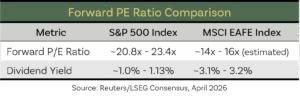
Valuation alone does not determine future returns, but it can be an indicator of future potential growth.
This is especially relevant after extended periods where one market segment significantly outperforms another.
Currency Diversification Matters Too
International investing can also provide diversification through currency exposure.
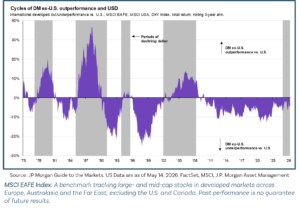
When the U.S. dollar weakens, foreign investments can benefit as overseas currencies strengthen relative to the dollar. Historically, periods of dollar weakness have often aligned with stronger relative performance from international equities.
Currency movements are never the sole reason to invest internationally, but they can create an additional layer of diversification that domestic-only portfolios simply do not have.
Diversification Beyond Technology
Today, the S&P 500 is increasingly concentrated among a relatively small group of large technology companies. According to data from J.P. Morgan Asset Management and FactSet, tech-related companies account for over 30% of the index’s market capitalization and profits. This concentration has made the S&P 500 riskier than in past decades; big tech experiences more price volatility than other sectors.
In other parts of the globe, international returns are more driven by sectors like financials, materials, industrials, and healthcare, as opposed to tech. International markets can help offset some of the U.S. tech concentration by offering exposure to these sectors, which are less dominant in the U.S. market today.
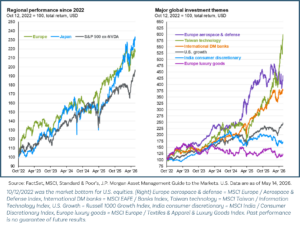
The left chart shows that Europe and Japan outperformed the S&P 500, excluding Nvidia, from October 2022 through April 2026. The chart on the right shows that over the same time period, the U.S. Russell 1000 Index performed only middle of the pack when compared to international sectors like European aerospace and defense, banks, Taiwan technology, and others. This diversification may help reduce portfolio volatility over time while creating opportunities to participate in different areas of global growth.
A Globally Diversified Portfolio Can Help Smooth the Ride
While no investment strategy eliminates risk entirely, a globally diversified portfolio can help investors stay positioned for opportunities wherever they emerge, allowing them to navigate uncertainty more effectively.
A global stock portfolio versus an all-U.S. stock portfolio has its tradeoffs. While an all-U.S. stock portfolio has had a higher annualized return from 1990–2025 by about 1.5–2%, it also endured higher volatility and a higher drawdown during market corrections versus a global portfolio over the same time period. Protecting the downside is just as important as capturing the upside. Investors are more likely to stick with their investments when downsides are not as severe, making a global portfolio something investors should not ignore.
At Carlson Investments, we believe thoughtful portfolio construction should reflect a global perspective while remaining aligned with each client’s individual goals and risk tolerance.
If you would like to discuss how international investing may align with your goals, we invite you to reach out today.
Carlson Investments does not provide tax, legal, or accounting advice. This content has been written for informational purposes only. Always consult your individual tax, legal, or financial professionals for advice tailored to your situation
Let's Talk
Finding a better way doesn’t start with you learning about investment strategy. It starts with us learning about you.
Let’s get started.
Contact Us