

Why does stock market volatility tend to increase ahead of midterm elections, and what can investors learn from history?
As we approach the 2026 midterm elections, investors may notice an uptick in market volatility. It’s a familiar pattern. Political uncertainty can make even seasoned investors uneasy, particularly when the potential outcomes could influence economic policy and market performance.
Much of this volatility can be attributed to uncertainty surrounding key policy issues, including taxation, healthcare, energy regulation, and federal spending. With the balance of power in Washington potentially shifting, investors are left wondering how the election results might affect the economy and their portfolios. But history offers an encouraging perspective. US markets are historically up 95% of the time in the year after an election.
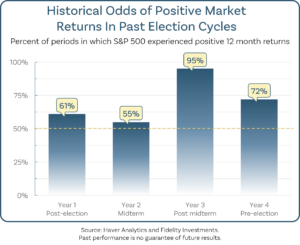
Methodology: Based on historical S&P 500 returns from 1950 to the present by election-cycle year. “Odds” represents the percentage of instances that the market went up (number of times the market went up divided by the total number of instances).
What History Tells Us About Midterm Elections
Historically, the stock market has often performed well in the year following midterm elections. There are several potential explanations for this:
- Greater policy clarity. Once election results are known, some of the uncertainty surrounding future legislation begins to fade. Investors and businesses gain a clearer picture of the political landscape, making it easier to evaluate opportunities and make financial decisions. Capital that had been sitting on the sidelines may begin flowing back into the market, potentially supporting stock valuations.
- The possibility of divided government. Midterm elections frequently change the balance of power in Congress. When control of the federal government is divided between political parties, sweeping tax increases or major regulatory changes can become more difficult to enact. This can create a more predictable legislative environment, which markets generally appreciate.
- A shift in political priorities. Following the midterms, attention begins turning toward the next presidential election. Policymakers may place greater emphasis on economic growth, targeted fiscal initiatives, and policies intended to support a favorable economic environment. While political outcomes are never guaranteed, this shift in priorities can influence market sentiment.
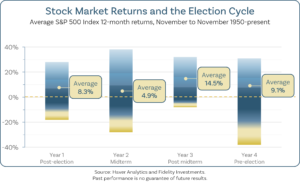
Why the Months Before Midterms Can Be Challenging
Historically, the six to nine months leading up to midterm elections have often been among the weaker periods of the four-year presidential election cycle. BlackRock’s analysis of the 2026 midterm elections and market performance offers additional perspective on how election cycles can influence investor behavior.
During this time, uncertainty about the direction of economic policy can encourage investors to take a more cautious approach. Some may reduce their exposure to equities, while others delay investment decisions until the political outlook becomes clearer.
Once the election passes, that defensive positioning may gradually unwind. As uncertainty subsides and investors regain confidence, markets have historically had opportunities to recover.
Of course, election results are only one factor influencing market performance. Interest rates, inflation, corporate earnings, and broader economic conditions continue to play significant roles, regardless of which party controls Congress. For additional perspective on how interest rates can signal changes in the economic outlook, read our article, Understanding the U.S. Treasury Yield Curve and Why It Matters to Investors.

Keeping the Long-Term Perspective
For investors, the most important takeaway may be the simplest: Short-term political uncertainty should not automatically lead to changes in a long-term investment strategy.
Market volatility can be uncomfortable, especially when headlines are dominated by election predictions and competing policy proposals. But reacting to every political development can mean losing sight of the financial goals that matter most.
At Carlson Investments, we believe successful investing requires discipline, perspective, and a strategy built around each client’s individual objectives. As we explore in our article, Why Endowments Win With a Long-Term Strategy, maintaining a long-term perspective can be an important part of navigating changing market conditions.
Understanding historical market patterns can help investors put today’s uncertainty into context without allowing short-term headlines to drive long-term decisions. While past performance does not guarantee future results, history offers a valuable reminder that periods of uncertainty are a normal part of investing.
Midterm elections will come and go. A thoughtful investment strategy should be designed to navigate many different political and economic environments.
If you’re wondering how current market conditions may affect your portfolio, we welcome the opportunity to discuss your investment strategy and long-term financial goals.
Carlson Investments is a Concord, New Hampshire-based financial advisor and investment manager.
Carlson Investments does not provide tax, legal, or accounting advice. This content has been written for informational purposes only. Always consult your individual tax, legal, or financial professionals for advice tailored to your situation.
Let's Talk
Finding a better way doesn’t start with you learning about investment strategy. It starts with us learning about you.
Let’s get started.
Contact Us